
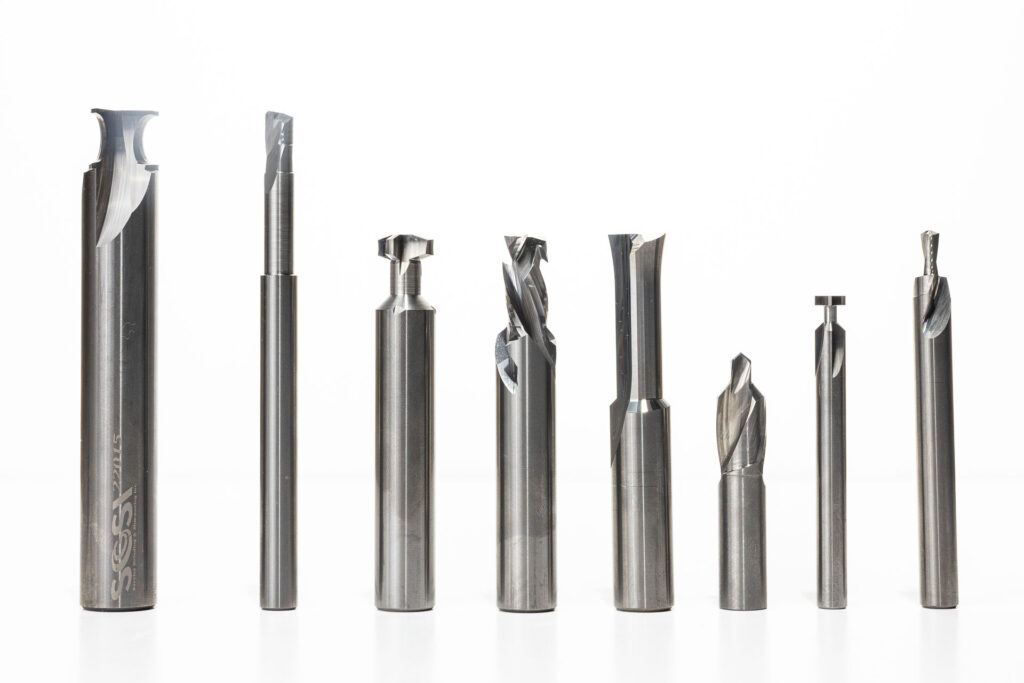
End mills are one of the biggest ongoing costs in a CNC shop, and most of them don’t wear out from cutting. They get chipped rattling around in a drawer, run in a dirty collet, or pushed a few hundred parts past the point where a light regrind would have saved them. Good end mill maintenance is mostly habits: how you store tools, how you hold them, how you run them, and when you pull them.
We’ve been sharpening end mills for Minnesota and western Wisconsin shops since 1976, and we see the results of those habits on our bench every week. Here’s what actually makes a difference, plus a simple routine you can start before the year-end slowdown.
Why end mills wear out early
A carbide end mill is extremely hard, but it’s also brittle. Most of the early failures we see come from one of four places:
- Handling damage. Corners and cutting edges get chipped when tools knock against each other in a drawer or bin.
- Runout. The tool isn’t spinning true in the holder, so one flute does most of the work and wears out first.
- Heat and chips. Poor chip evacuation means the tool recuts its own chips, builds heat, and breaks down the edge.
- Running too long. A dull tool takes more force to cut. More force leads to chipping, and once the edge is chipped, a regrind has to take off a lot more material to clean it up.
Store and handle end mills like precision tools
The fastest way to ruin a good end mill is to toss it in a drawer with ten others. Carbide edges chip when they touch other carbide.
- Keep every end mill in its own tube, sleeve, or slotted holder, whether it’s new or used.
- Keep dull tools separate from sharp ones, and label them so they don’t end up back in a machine by mistake.
- Wipe off coolant and chips before tools go back into storage. Dried residue can hide edge damage you’d otherwise catch.
- Don’t set tools down cutting edge first on a steel bench or machine table.
- Keep one bin just for tools headed out for regrinding, with each tool still in its own tube.
That last one matters more than most people think. A tool that gets chipped on the way to the grinder costs more to fix than one that shows up with only normal edge wear.
Check your tool holding and runout
Runout is when the cutting edges don’t all spin on the same circle. Even a small amount means one flute takes a bigger bite than the others, wears faster, and leaves a worse finish. On small-diameter tools, it’s often the difference between a tool that lasts and one that snaps.
- Clean collets, collet nuts, and holder tapers on a regular schedule. One chip stuck in a collet can throw a tool off.
- Replace worn collets. They cost very little compared to the tools they hold.
- Indicate critical tools after setup, especially small end mills and finishing tools.
- Use the shortest stickout the job allows. Extra length magnifies runout and adds deflection.
Concentricity matters on our side too. After we regrind a tool on one of our ANCA FX7 CNC grinders, we check runout on a Vollmer concentric measuring system so it comes back running true. If you’re curious what happens to your tools once they leave your shop, we walk through it step by step in how CNC tool sharpening works, from drop-off to delivery.
Run them the way they were designed to run
A few basics go a long way:
- Start with the manufacturer’s speeds and feeds. Then adjust from there. Running too light a feed can be as hard on an edge as running too heavy, because the tool rubs instead of cutting.
- Get the chips out. Chips that pack into the flutes get recut, which adds heat and chips the edge. Use coolant or air blast that actually reaches the cut, especially in deep pockets and slots.
- Keep your coolant healthy. Concentration that drifts too lean, or a sump full of tramp oil, affects tool life and your parts. OSHA’s metalworking fluids best practices manual has a solid section on setting up a fluid management program.
- Match the tool and coating to the material. A tool built for aluminum won’t last long in stainless, and the reverse is also true.
When a tool does wear out, the wear pattern tells you why. Seco Tools has a useful breakdown of common end mill wear patterns and what causes them. It’s worth looking at your dull tools under a loupe before they go in the regrind bin. If every tool from one machine shows the same damage, the problem is probably the machine or the setup, not the tool.
Know when to pull a tool
This is the biggest one. Most shops run end mills too long. These are the signs a tool is ready to come out:
- Surface finish is getting worse on the same program.
- Burrs are showing up on part edges that used to come off clean.
- The cut sounds different, or you start getting chatter.
- Spindle load is creeping up.
- Parts are drifting toward the edge of tolerance.
- You can see flank wear or small chips on the edge under magnification.
Here’s why pulling a little early pays off. A tool with normal edge wear only needs a light regrind, which takes off very little diameter. That leaves room for more regrinds over the life of the tool. A tool that runs until it chips or breaks may not be worth saving at all. If you’re not sure where that line is, our guide on when to resharpen vs. replace your cutting tools walks through it.
The easiest way to stop guessing is to track it. Pick your most-used tools and note how many parts or how many minutes of cutting each one gets before it needs to come out. After a few cycles, you’ll have a pull point you can trust.
How regrinding fits into end mill maintenance
Regrinding isn’t a last resort. It’s part of the maintenance cycle. When your tools come to us, here’s what happens:
- Every tool is cleaned in an ultrasonic tank, so we can see the real condition of the edge.
- We inspect and measure each tool. If one is too damaged or too undersized to be worth grinding, we let you know before doing any work.
- We grind to OEM geometry on our ANCA FX7 grinders, programmed in ANCA’s CIM3D software.
- We inspect again for geometry, edge quality, and runout.
- If you want, we recoat. We offer AlTiN, TiN, ZrN, TiLAN, DLC, AlCrN, and TiCN.
We handle carbide and HSS end mills (flat, ball nose, corner radius, and tapered), roughing end mills, carbide drills, and CNC router bits. You can see the full list on our end mill resharpening service page. Most of our end mill work comes from machine shops and metalworking plants, but we also sharpen a lot of tooling for plastics manufacturers, where a dull edge melts and burrs the part instead of cutting it.
If you run a special that you can’t buy off the shelf, we can also make custom end mills and other cutting tools from carbide blanks, from a single piece up to production batches. And for router work, we make our own line of Frost CNC Tooling right here in Stacy.
Where to start: a simple end mill maintenance routine
Late December is a good time to do this. A lot of shops slow down between Christmas and New Year’s, and it’s the natural moment to sort the tool crib before the new year’s work starts. Here’s a routine that doesn’t take much time:
- Sort the tool crib. Split everything into three piles: new or sharp, dull but in good shape, and chipped or broken.
- Get every tool into its own tube or holder. No loose tools in drawers.
- Clean and check your holders. Clean collets and tapers, and replace collets that are worn or damaged.
- Set pull points. Pick the 5 to 10 tools you use most and decide when each one comes out.
- Start a regrind bin. Dull tools go in, each in its own tube, and get sent out on a regular schedule instead of all at once.
- Keep a backup set. A second set of your most-used tools means a regrind never holds up a job.
- Look at the patterns. Once a quarter, check which tools come back chipped versus normally worn.
If you send your dull tools early in December, they’ll be back and ready for your January startup. If your plant also runs slitter or converting knives, the same thinking applies there. See our guide to slitter blade sharpening.
Frequently asked questions
How often should end mills be resharpened?
There’s no single number, because it depends on the material, the tool, and how hard you run it. The better approach is to pull a tool at the first signs of wear (worse finish, burrs, chatter, or rising spindle load) and track how many parts or cutting minutes it got. Tools pulled with normal edge wear need a lighter regrind, which usually means more regrinds over the life of the tool.
Can carbide end mills be sharpened?
Yes. We regrind solid carbide and HSS end mills, including flat, ball nose, corner radius, tapered, and roughing styles, on CNC tool grinders to OEM geometry. A tool that’s badly chipped, broken, or already too far undersized may not be worth regrinding, and we’ll tell you that up front instead of grinding it anyway.
Does regrinding remove the coating?
Regrinding removes coating from the cutting edge, which is normal. If you want the tool coated again, we can recoat it after grinding and inspection. We offer AlTiN, TiN, ZrN, TiLAN, DLC, AlCrN, and TiCN, and we’re happy to help you pick the right one for what you’re cutting.
How long does end mill regrinding take?
Most orders come back in about a week, and rush service is available when you need it. We offer pickup and delivery within 100 miles of the Twin Cities, or you can drop tools off at our shop in Stacy or ship them in.
Ready to get more life out of your end mills?
Whether you’ve got a handful of tools or a full bin, we’ll inspect them, tell you what’s worth saving, and get them back to you ground to spec. Request a quote or schedule a pickup, or call us at 763.786.9652, Monday through Friday, 7:00 to 4:30.
Need tooling or blades sharpened?
We've been grinding and sharpening for Minnesota and Wisconsin shops since 1976. Send us a list or a photo and we'll get you a quote. Pickup and delivery within 100 miles of the Twin Cities.