
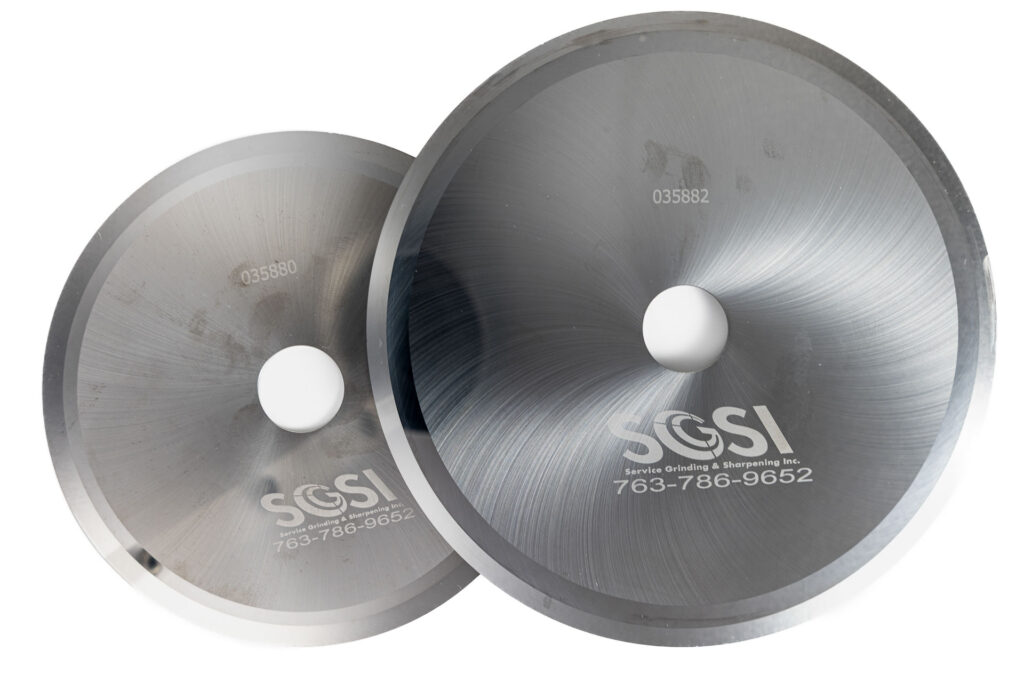
Slitter blades don’t usually fail all at once. They get a little duller every shift, and the line slowly starts telling you about it: more dust, fuzzier edges, rolls that don’t wind as clean as they used to. By the time someone says “we need new knives,” the blades have often been costing you scrap and downtime for weeks.
We sharpen slitter knives from 1 to 24 inches for paper, film, foil, packaging, rubber, and textile operations around Minnesota and western Wisconsin. This guide covers how to tell when your blades are due, what shortens their life, and how to plan sharpening so it never stops a line, including around the year-end shutdown a lot of plants are planning right now.
Shear, crush, and razor slitting: what gets sharpened
Most converting and packaging lines use one of three slitting methods, and each one treats its blades differently:
- Shear slitting works like a pair of rotary scissors. A top knife overlaps a bottom knife and the web is cut between them. It handles almost any material and gives the cleanest edge, but both knives wear, and setup matters a lot.
- Crush (score) slitting presses a rounded knife edge through the web against a hardened anvil roll. It’s common for tapes, labels, and nonwovens. It’s simple to set up, but it tends to create more dust and wears knives faster.
- Razor slitting uses a thin blade, often in a holder, for films and foils. Most razor blades are made to be replaced, not resharpened.
Converting Expert’s overview of the three main slitting methods in PFFC is a good read if you want to go deeper on setup. For sharpening, the takeaway is simple: shear and crush knives are the ones worth regrinding, and they make up most of what we see come through our shop.
Signs your slitter blades need sharpening
Operators usually notice before anyone else does. Watch for these:
- More dust and fines at the slit, especially on paper and paperboard.
- Fuzzy, frayed, or torn edges on paper, nonwovens, and textiles.
- Stretched, wavy, or ragged edges on film and foil.
- Tearing or a rough cut face on rubber sheet and belting.
- Rolls that wind poorly because of edge defects, or more web breaks than usual.
- Operators adding pressure, overlap, or side force to keep the cut clean. That’s a sign the edge is doing less of the work.
- Visible nicks, rounding, or a bright worn band along the edge when you look closely.
That last-ditch adjusting is the one to watch. Cranking up pressure or overlap to make a dull knife cut can damage the bottom knife and wear both knives faster. A sharp edge is almost always cheaper than the workaround.
What shortens slitter blade life
Some wear is normal. A lot of it isn’t. These are the most common reasons we see slitter knives come in worn out early:
- Setup that’s off. Too much overlap, too much side load, or the wrong cant angle on shear slitters puts extra stress on the edge.
- Running dull too long. The longer a dull blade runs, the more material we have to grind off to get back to a clean edge, and the fewer times that blade can be resharpened.
- Handling damage. Knives stacked loose, dropped, or stored without edge protection get nicked before they ever go back on the shaft.
- Buildup. Adhesive, coatings, and residue from labels and tapes build up on the edge and change how it cuts.
- Mixing sets. Pairing knives with different wear or different diameters on the same shaft can lead to uneven cuts and uneven wear.
Why a regrind needs to match the original edge
A slitter knife isn’t just “sharp or dull.” The bevel angle, edge finish, and flatness all affect how it cuts. A regrind that changes the geometry can leave you with a knife that’s sharp but doesn’t cut the way it used to.
Here’s how we handle slitter knives:
- We clean every knife ultrasonically and inspect it before any grinding starts, so we can see the real condition of the edge.
- We grind on German-built Göckel knife grinders, holding the angles, bevels, and tolerances the knife was made to.
- We inspect again before the knives are packaged and sent back.
If you run sets, tell us. Keeping knives in matched sets helps your operators set up faster and get consistent cuts across the web. You can see every type of blade we handle, from slitter knives to paper knives up to 153 inches long, on our industrial knife and blade sharpening page.
Slitter blades by industry
The same basics apply everywhere, but what you’re cutting changes what you watch for:
- Rubber and textiles. Rubber sheet, V-belt stock, fabric, and fiber are tough on edges and show tearing fast when a knife dulls. We sharpen V-belt slitter blades and textile knives for rubber and textile operations across the region.
- Plastics and film. A dull knife on film generates heat, which can melt or stretch the edge. Our plastics customers send us slitter knives for sheet, film, and packaging lines.
- Food packaging. Slitter knives for packaging, film, and wrapping come through with the rest of our food processing blade sharpening, using food-safe processes and returned sealed.
- Paper, labels, and bindery. Dust is usually the first sign here, followed by fuzzy edges and winding problems.
If your line isn’t on this list, it’s probably still something we work on. You can see the full range on our industries we serve page.
Plan sharpening around your downtime
The best way to make sure sharpening never stops a line is to stop treating it as an emergency. A few things that help:
- Keep a spare set. One set runs while the other is out being sharpened. Swap them on a schedule instead of waiting for a bad cut.
- Use planned shutdowns. If your plant slows down or shuts down between Christmas and New Year’s, that’s a natural time to swap every knife. Get the dull set out to us early in December so it’s back before January startup.
- Track how long a set lasts. Log footage, run hours, or rolls per set. After a few cycles, you’ll know when to swap before quality slips.
- Ship knives protected. Edge guards or separators between knives keep them from getting nicked on the way to us.
We offer pickup and delivery within 100 miles of the Twin Cities. That covers the metro plus places like St. Cloud, Rochester, Mankato, Hutchinson, Brainerd, Alexandria, and Eau Claire. You can also drop knives off at our shop in Stacy or ship them in.
A quick note on safety during blade changes
Slitter knives are sharp enough to cause serious cuts even when they’re “dull” for production. Any blade change should follow your lockout/tagout procedure, so the shafts can’t move while hands are near the knives. OSHA’s control of hazardous energy (lockout/tagout) page is the starting point. Minnesota runs its own program through the Department of Labor and Industry, and OSHA’s Minnesota State Plan page explains how MNOSHA fits in. Cut-resistant gloves and knife guards for storage and transport are worth the small cost.
Where to start: a slitter blade checklist
- Count your knives. Know how many top and bottom knives each line runs, and how many spares you have.
- Check the edges. Pull a knife at the next changeover and look for nicks, rounding, or buildup.
- Ask your operators. Have they been adding pressure or overlap to keep a clean cut? That tells you a lot.
- Build a spare set for your highest-volume line if you don’t have one.
- Pick a swap schedule based on footage, hours, or rolls instead of waiting for a bad cut.
- Book the holiday swap. If you have a year-end shutdown, schedule a pickup in early December.
- Store knives protected, with guards or separators, never stacked loose.
If you also run CNC machines in the same plant, the same habits pay off for your cutting tools. Our end mill maintenance guide covers that side.
Frequently asked questions
How often should slitter blades be sharpened?
It depends on the material, line speed, and slitting method, so there isn’t one number that works for every plant. The practical answer is to watch for the early signs (more dust, fuzzy or stretched edges, operators adding pressure) and track footage or run hours per set. After a few cycles, you’ll have a swap schedule that keeps quality steady.
Can razor slitter blades be sharpened?
Most razor blades are designed to be thrown away and replaced. Shear slitter knives and crush (score) knives are the ones that are usually worth regrinding. If you’re not sure about a specific blade, send us a photo or a sample and we’ll tell you.
What size slitter knives do you sharpen?
We sharpen slitter knives from 1 to 24 inches for paper, film, foil, packaging, rubber, and textile applications. For straight knives, like paper knives, we handle blades up to 153 inches long.
Do you pick up and deliver slitter knives?
Yes. We offer pickup and delivery within 100 miles of the Twin Cities. You can also drop knives off at our shop in Stacy, MN, or ship them to us from anywhere.
Get your slitter knives back to a clean cut
Send us your dull knives, or just a photo and a count, and we’ll tell you what’s worth sharpening and when you can have them back. Request a quote or schedule a pickup, or call us at 763.786.9652, Monday through Friday, 7:00 to 4:30.
Need tooling or blades sharpened?
We've been grinding and sharpening for Minnesota and Wisconsin shops since 1976. Send us a list or a photo and we'll get you a quote. Pickup and delivery within 100 miles of the Twin Cities.